
Ayatul Kursi Urdu & English Translation
Read Online & Download PDF
Ayatul Kursi is a powerful verse from Surah Al-Baqarah (2:255) that highlights the greatness, knowledge, and authority of Allah Almighty. It is widely recited by Muslims for protection, peace, and remembrance of Allah in daily life.
On this page, you can read Ayatul Kursi online with authentic Arabic text along with clear and accurate Urdu and English translation. A downloadable PDF is also available for easy offline reading, learning, and sharing.

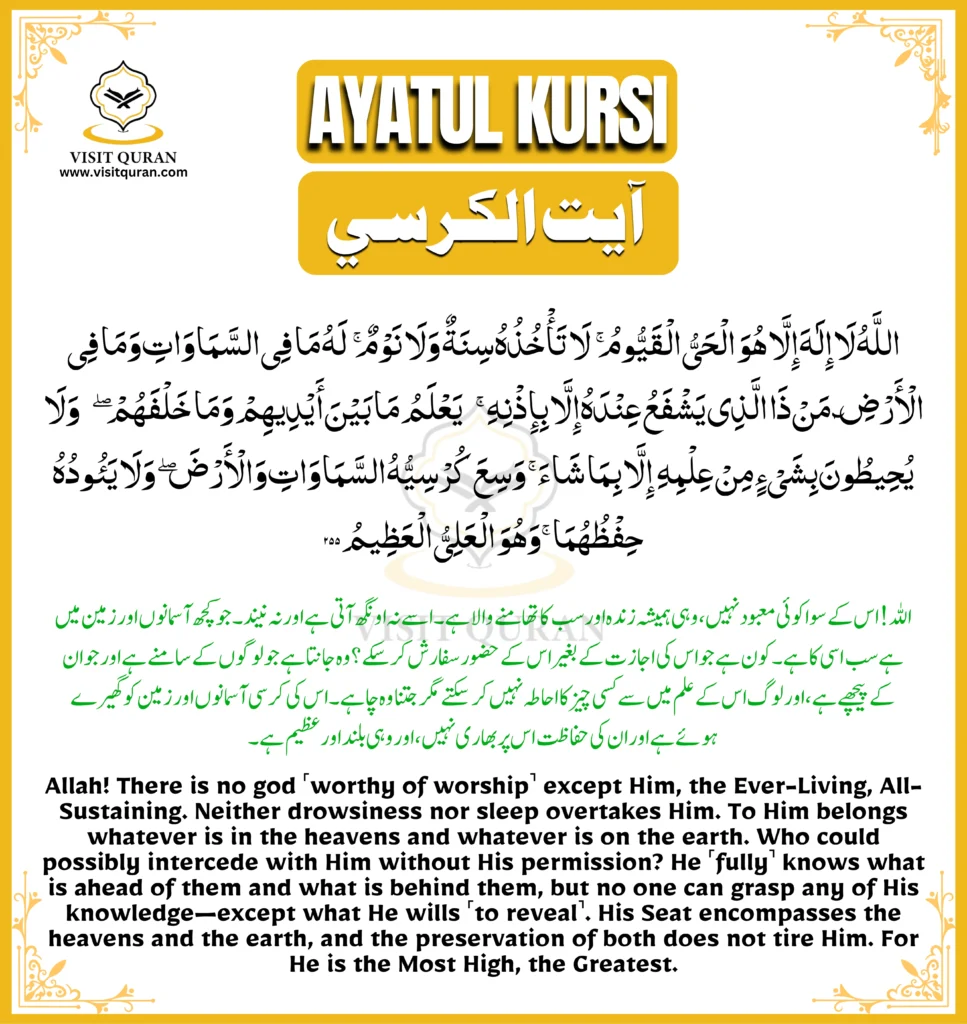
Ayatul Kursi in Arabic
اللَّهُ لاَ إِلَهَ إِلاَّ هُوَ الْحَيُّ الْقَيُّومُ لاَ تَأْخُذُهُ سِنَةٌ وَلاَ نَوْمٌ لَهُ مَا فِي السَّمَاوَاتِ وَمَا فِي الأَرْضِ مَنْ ذَا الَّذِي يَشْفَعُ عِنْدَهُ إِلاَّ بِإِذْنِهِ يَعْلَمُ مَا بَيْنَ أَيْدِيهِمْ وَمَا خَلْفَهُمْ وَلاَ يُحِيطُونَ بِشَيْءٍ مِنْ عِلْمِهِ إِلاَّ بِمَا شَاءَ وَسِعَ كُرْسِيُّهُ السَّمَاواتِ وَالأَرْضَ وَلاَ يَئُودُهُ حِفْظُهُمَا وَهُوَ الْعَلِيُّ الْعَظِيمُ
Read Ayatul Kursi Transliteration
“Allahu laaa ilaaha illaa huwal haiyul qai-yoom. laa taakhuzuhoo sinatunw wa laa nawm; lahoo maa fissamaawaati wa maa fil ard man zallazee yashfa’u indahooo illaa be iznih ya’lamu maa baina aideehim wa maa khalfahum wa laa yuheetoona beshai ‘immin ‘ilmihee illa be maa shaaaa wasi’a kursiyyuhus samaa waati wal arda wa la ya’ooduho hifzuhumaa wa huwal aliyyul ‘azeem.”
Ayatul Kursi English Translation
- Allah! There is no god ˹worthy of worship˺ except Him, the Ever-Living, All-Sustaining.
- Neither drowsiness nor sleep overtakes Him.
- To Him belongs whatever is in the heavens and whatever is on the earth.
- Who could possibly intercede with Him without His permission?
- He ˹fully˺ knows what is ahead of them and what is behind them,
- but no one can grasp any of His knowledge—except what He wills ˹to reveal˺.
- His Seat encompasses the heavens and the earth,
- and the preservation of both does not tire Him.
- For He is the Most High, the Greatest.
Ayatul Kursi Urdu Translation
اللہ! اس کے سوا کوئی معبود نہیں، وہی ہمیشہ زندہ اور سب کا تھامنے والا ہے۔ اسے نہ اونگھ آتی ہے اور نہ نیند۔ جو کچھ آسمانوں اور زمین میں ہے سب اسی کا ہے۔ کون ہے جو اس کی اجازت کے بغیر اس کے حضور سفارش کر سکے؟ وہ جانتا ہے جو لوگوں کے سامنے ہے اور جو ان کے پیچھے ہے، اور لوگ اس کے علم میں سے کسی چیز کا احاطہ نہیں کر سکتے مگر جتنا وہ چاہے۔ اس کی کرسی آسمانوں اور زمین کو گھیرے ہوئے ہے اور ان کی حفاظت اس پر بھاری نہیں، اور وہی بلند اور عظیم ہے۔

Start Learning Quran With us, anywhere you are.
Learn the Holy Quran with expert male and female teachers from the comfort of your home. Our qualified Quran tutors help kids and adults improve Tajweed, Tilawat, and memorization through personalized one-on-one sessions. Start your Quran learning journey today and build a stronger connection with Allah. Click here
What Is Ayatul Kursi?
The term “Ayatul Kursi” literally means “Throne of Allah.” To read Ayatul Kursi, you have to open the chapter of Surah Al Baqarah verse 255.The Holy Quran’s third paragraph (تِلْكَ الرُّسُلُ) has it. The “Throne Verse” is another name for it. Every Muslim’s fundamental belief is to recite and adhere to it on a regular basis.
Benefits of Ayat ul Kursi
Reciting Ayatul Kursi holds numerous spiritual benefits and is considered one of the most powerful verses of the Holy Quran. Due to its profound meaning and virtues, it plays an important role in the daily life of a Muslim. Some of its key benefits include:
1. Protection from Harm
One of the most well-known benefits of Ayatul Kursi is protection from harm. It is reported in a hadith that the Prophet Muhammad (PBUH) said: “Whoever recites Ayat Al Kursi after every obligatory prayer, nothing will stand between him and Paradise except death.” (Sahih Muslim)
This Hadith highlights the immense value of reciting Ayat Al Kursi regularly as a means of safeguarding oneself from physical and spiritual harm.
2. Protection from Shaytaan (Satan)
Reciting Ayatul Kursi acts as a barrier between an individual and evil influences, including the Shaytaan. A well-known narration mentions that when recited at night, Allah appoints an angel to protect the person until the morning.
3. Mental and Spiritual Peace
Ayat ul Kursi offers great peace of mind and heart. Its words emphasize Allah’s control over the heavens and the earth, reminding the believer that everything is under His care. This reflection helps ease anxiety and worry.
4. Gaining Knowledge and Wisdom
Ayatul Kursi highlights Allah’s infinite knowledge, which is beyond human comprehension. Regular recitation of this verse is believed to bring blessings, understanding, and increased wisdom.
Best Times to Recite Ayatul Kursi
Ayatul Kursi can be recited at various times to seek blessings, protection, and spiritual strength:
After each obligatory prayer: It is highly recommended to recite Ayatul Kursi after the five daily prayers to gain protection and barakah.
Before sleeping: Reciting it before going to bed provides spiritual protection and peace throughout the night.
When leaving home: Many Muslims recite it before stepping out for safety and divine protection during their travels.
During difficult times: It brings calm, courage, and spiritual strength in moments of hardship, fear, or anxiety.
Hadiths about Ayatul Kursi
(Al-Tirmidhi, Hadith 2144) The Prophet (ﷺ) said:
“Whoever recites Ha-Mim al-Mu’min to ‘to Him is the final goal and destination’ and Ayatul Kursi in the morning, they will be safeguarded until evening. Reciting them in the evening will safeguard them until morning.”
(Al-Mu’jam Al-Kabir, 7406) The Prophet (ﷺ) also said:
“Whoever recites Ayatul Kursi after every prescribed Salah/Namaz (Prayer), nothing stands between them and Paradise except death.”
How to Memorize Ayatul Kursi?
7 Easy Steps to Memorize Ayatul Kursi
Practice Regularly: Consistent repetition is key to memorization.
Listen and Learn: Play recitations and use transliteration to familiarize yourself with the verse.
Break It Down: Divide the verse into smaller, manageable sections and memorize each part gradually.
Use Active Recall: Recite from memory, progressively combining the sections as you go.
Recite Daily: Incorporate Ayatul Kursi into your daily routine and free moments for practice.
Be Consistent: Maintain patience and practice persistently every day.
Seek Spiritual Assistance: Remember the benefits of memorization and ask Allah for guidance and ease in learning.
Most Popular Question about Dua e Qunoot:
What is the meaning of Ayatul Kursi?
According to Ayatul Kursi, “Allah is the one real God with flawless qualities. He is in charge of everything, never sleeps or is exhausted, and nothing occurs without His will.”
In which surah is Ayatul Kursi?
Ayatul Kursi is in verse 255 of Surah Al-Baqarah.
Can we recite an ayat without wudu?
Yes, ofcourse you can recite the Quran from your memory or on your tablet or mobile phone screens any time without Wudu. But if you are going to read the Holy Quran, make sure you are clean so your mind stays in focus.
What is Ayatul Kursi?
Ayatul Kursi is the 255th verse of Surah Al‑Baqarah in the Holy Quran. It speaks about Allah’s absolute authority, knowledge, and sovereignty over the heavens and the earth, and it emphasizes that nothing is comparable to Him.
When should I recite Ayatul Kursi?
Ayatul Kursi can be recited at many times, but it is especially recommended:
After each obligatory (fard) prayer
Before sleeping at night
In the morning after Fajr and in the evening after Asr or Maghrib
During times of fear or anxiety
These moments help in seeking Allah’s protection and blessings throughout the day and night.
How many times should Ayatul Kursi be recited each day
There is no fixed number specified in authentic sources. However, many scholars recommend reciting it at least after every obligatory prayer and before sleeping. You may also recite it more often according to your devotion and convenience.
Does reciting Ayatul Kursi bring protection?
Yes. It is well‑reported that reciting Ayatul Kursi before sleeping brings Allah’s protection throughout the night, and reciting it at other times brings spiritual safeguards. It is also considered part of daily remembrances for protection against evil and harm.
Is Ayatul Kursi recommended to be recited when leaving home?
Yes. Reciting Ayatul Kursi before stepping out of the home is a common practice among Muslims, seeking Allah’s safety and blessings during travel or daily activities.
Can Ayatul Kursi help in difficult times or anxiety?
Many Muslims recite Ayatul Kursi when facing fear, stress, or hardship. Its recitation can bring a sense of calm and reminder of Allah’s power and presence, aiding one’s spiritual focus and tranquility.
Can non‑Muslims read or learn Ayatul Kursi?
Yes. While Ayatul Kursi is part of Islamic practice, non‑Muslims are welcome to read its meaning and translation to understand its message about Allah’s greatness and attributes.
Is Ayatul Kursi part of daily adhkar (remembrance)?
Yes. Many scholars include Ayatul Kursi in daily adhkar because of its virtues and importance in strengthening one’s connection with Allah and remembrance after prayers or before sleep.
Does Ayatul Kursi protect against Shaytan (Satan)?
Reciting Ayatul Kursi with belief and understanding is widely practiced for seeking Allah’s protection from spiritual harm, including negative influences. It serves as a reminder of Allah’s power over all things.
Does reciting Ayatul Kursi increase faith (iman)?
Reciting Ayatul Kursi with understanding and reflection can strengthen a believer’s consciousness of Allah’s attributes, which in turn may deepen one’s faith and trust in Allah.
Are there authentic hadiths about Ayatul Kursi?
Yes. Several authentic narrations mention the virtues of Ayatul Kursi, including benefits related to protection after prayer and before sleeping. These hadiths are found in collections such as Sahih al‑Bukhari and Sahih Muslim. some of them below:
(Al-Tirmidhi, Hadith 2144) The Prophet (ﷺ) said:
“Whoever recites Ha-Mim al-Mu’min to ‘to Him is the final goal and destination’ and Ayatul Kursi in the morning, they will be safeguarded until evening. Reciting them in the evening will safeguard them until morning.”
(Al-Mu’jam Al-Kabir, 7406) The Prophet (ﷺ) also said:
“Whoever recites Ayatul Kursi after every prescribed Salah/Namaz (Prayer), nothing stands between them and Paradise except death.”